Who this guide is for
Pediatric dental practices and kids’ dental offices whose visitors are mostly parents and caregivers deciding for a child
What patients need to accomplish
- Understand when and how a child’s first dental visit happens, and how to prepare for it
- Confirm the practice serves the child’s age and, where verified, the family’s insurance or Medicaid plan
- Reach the practice’s approved scheduling route without sending a child’s health details through a public form
01 / Practice blueprint
Write for the parent standing in the hallway at 7 a.m.
The primary visitor on a pediatric dental site is rarely the patient. It is a parent or caregiver, often on a phone, sometimes with a toddler in one arm, trying to answer a short list of questions: is this the right kind of office for my child, when should we come in, what will happen, and how do I book. Navigation should answer those questions in that order rather than leading with a technology list or a mission statement.
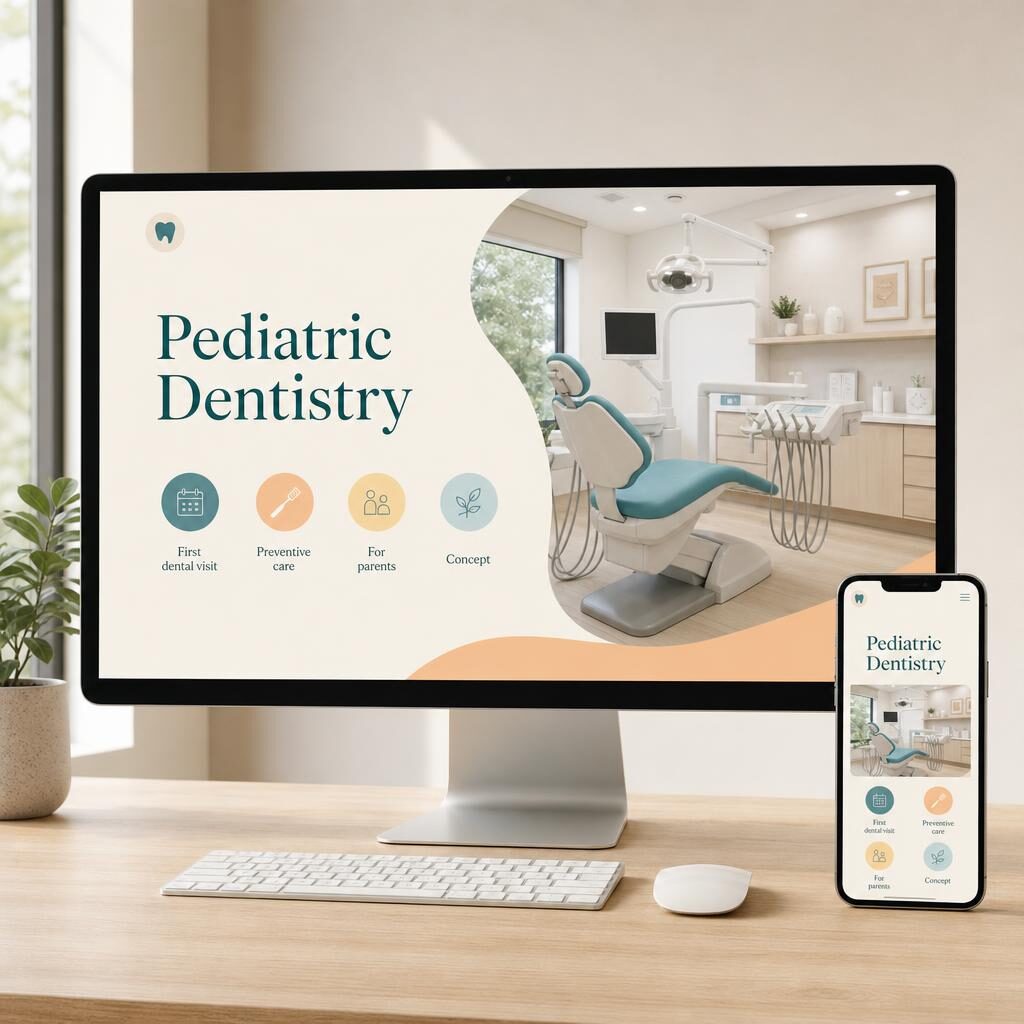
Organize the homepage around the family journey: a first-visit section, a preventive care section, a short explanation of what kinds of treatment the office provides, and one clear scheduling route. Returning families need a separate, labeled path to forms, the portal or the phone, so they never have to re-read the new-family content.
- New family: what kind of practice, ages served, first visit, preparation, scheduling
- Returning family: forms, portal, hours, directions, phone
- Referring dentist or pediatrician: referral instructions the office approves
- Urgent dental concern: practice-approved guidance on whom to call; no online triage
02 / Practice blueprint
Make the first dental visit the heart of the site
The American Academy of Pediatric Dentistry encourages a first dental visit when the first tooth appears and no later than a child’s first birthday. Many parents do not know this, so a well-written first-visit page is both genuinely useful and a natural search entry point. Present the recommendation in plain language, attribute it to the source, and let the practice add its own approach to that visit.
A strong first-visit page explains what the office typically does at that appointment, how long it usually takes, whether a parent stays in the room, what to bring, and how to talk to a child beforehand, all written or approved by the dental team. Preparation guidance can include practical items such as arriving early for paperwork or bringing an insurance card; it should not drift into clinical instructions the practice has not reviewed.
Review checklist
- First-visit timing stated and attributed to AAPD
- Visit description written or approved by the dentists
- What to bring and when to arrive
- Whether caregivers stay with the child, per office policy
- One clear scheduling route at the end of the page
03 / Practice blueprint
Explain treatment at a family reading level, with the practice’s words
Preventive care pages (checkups, cleanings and other services the office actually offers) should explain the purpose of each visit in a sentence or two a parent can repeat to a child. Treatment pages can describe what a procedure is for and what the family can ask the dentist, using age-appropriate explanations the practice approves.
Sedation, anesthesia, medication and post-treatment care instructions belong to the clinical team. The website can say that the dentist discusses options at the visit and link to practice-supplied instructions; it should never paraphrase dosing or aftercare on its own. Avoid “pain-free” and “guaranteed” language entirely.
04 / Practice blueprint
Insurance and Medicaid: state only what is verified
Families often search specifically for whether a kids’ dentist participates in their plan, including state Medicaid or CHIP dental programs. If the practice participates and confirms it, saying so clearly is valuable. If it does not, or participation is limited by location or provider, the page should say that too, or stay silent rather than imply coverage.
Treat the insurance page as a maintained list with a named staff owner and a last-reviewed date. Encourage families to confirm individual benefits with the office and their plan. Never present an estimate of out-of-pocket cost as final.
05 / Practice blueprint
Accessibility, special health care needs and bilingual families
Pediatric dental offices often serve children with special health care needs and families who rely on assistive technology. Test every critical page with a keyboard and screen reader, keep contrast strong despite playful palettes, and describe physical accessibility (entrances, parking, quiet rooms if available) only as the office confirms it.
Bilingual content should be commissioned and reviewed by a qualified translator and checked by bilingual staff, not produced through a free automatic widget. Translate the full family journey: first visit, preparation, insurance, forms and scheduling. Give each language version its own URL with reciprocal hreflang, and be honest about which staff can actually communicate in that language.
06 / Practice blueprint
Local SEO for a kids’ dental office, without ranking promises
Search visibility starts with one strong page per real topic, consistent name, address and hours across the site and the business profile, and helpful first-visit and preventive care content. Location pages should reflect actual offices with real details, not duplicated pages for every nearby town.
Foundational technical SEO and structured data can help search engines understand the site. No one can guarantee rankings, map placement, AI citations or new-patient volume, and the website should not imply otherwise.
Content guardrails
What this website should not claim
- No treatment, sedation or medication instructions written by the web team; clinical wording comes from the practice
- No “accepts all insurance” or Medicaid claims unless participation is verified and kept current
- No fictional dentists, credentials, awards, reviews or testimonials
- No child health history, photos or symptoms collected through the public contact form
- No promise that every child will have a calm or painless visit
Questions
Pediatric Dentistry websites: common questions
Related in the studio library
Sources & reading
- American Academy of Pediatric Dentistry — Parent FAQ
- U.S. Department of Justice — ADA web accessibility guidance
- W3C — Web Content Accessibility Guidelines 2.2
- Google Search Central — Localized versions of pages
- Google Search Central — Creating helpful, people-first content
- HHS OCR — HIPAA and cloud computing