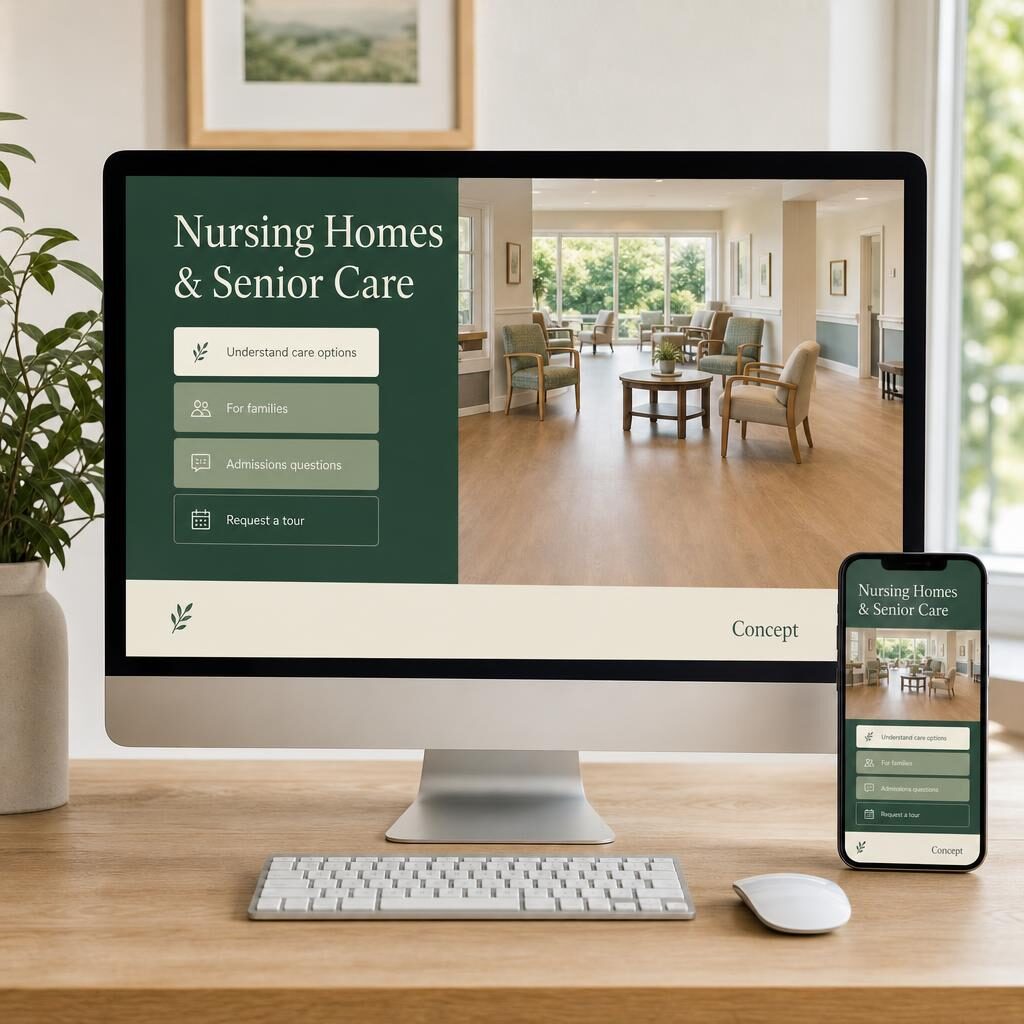
Who this guide is for
Nursing homes, skilled nursing facilities and long-term care communities whose visitors are mostly adult children, spouses and hospital discharge planners
What families need to accomplish
- Understand which kind of care this facility actually provides, and how it differs from assisted living, memory care and independent living
- Find admissions questions, visiting policy, location and accessibility details the facility has confirmed
- Request a tour or an admissions conversation, knowing that a request is not a booking or a bed confirmation
01 / Practice blueprint
Design for a family making a hard decision quickly
The people reading a nursing home website are rarely the future resident. They are adult children, spouses and sometimes hospital discharge planners, often comparing several facilities within days of a hospital stay. They are tired, worried and short on time. The site should help them understand what this facility does, what to ask, and how to see it in person.
Lead with a care-type explanation, then a plain facility and service overview, then admissions questions and a tour request. Location, parking, accessible entrances and visiting policy belong close to the tour request because families plan visits around them.
- Family researching care: care types, services, staffing, payment questions, tour request
- Discharge planner or referral source: admissions contact and referral process the facility approves
- Current resident family: visiting policy, hours, contacts, events the facility publishes
- Prospective staff: careers page kept separate from family content
02 / Practice blueprint
Explain care types before describing services
The National Institute on Aging describes how long-term care facilities differ in the amount of medical support they provide, and notes that specific arrangements vary by state and facility. A care-types page that explains skilled nursing, nursing home care, assisted living, memory care and independent living in plain words helps families narrow their search honestly.
Then say clearly which of these this facility provides, and which it does not. A family that needs a level of care the facility does not offer is better served by learning that on the website than after a tour. That honesty is a design decision, not a weakness.
03 / Practice blueprint
Describe services, staffing and clinical care only as verified
Service pages should describe the actual service mix: skilled nursing, rehabilitation therapies, long-term residential care or other services the facility is licensed and authorized to provide. Staffing descriptions such as nurse coverage, therapist roles and physician involvement should come from the facility, use its exact wording, and carry a named reviewer.
Avoid outcome language such as recovery rates, “best care” or comparisons with other facilities. Do not publish license numbers, inspection results or CMS ratings unless the facility supplies them and commits to keeping them accurate; stale ratings mislead families.
Review checklist
- Service mix confirmed by facility leadership
- Licensing language reviewed by the facility
- Staffing and clinical descriptions approved and dated
- No ratings or awards without current documentation
- Careers content kept off family pages
04 / Practice blueprint
Payment pages: explain the questions, never promise coverage
Medicare.gov explains that Medicare generally does not pay for most non-medical, custodial long-term care, and that skilled nursing facility care may be covered for a limited time only when specific conditions are met. Medicaid eligibility and coverage vary by state. A family-facing payment page can explain these distinctions in general terms and link to official sources.
The safest copy asks families to confirm individual benefits directly with the facility’s admissions team and their payer. List the payment types the facility actually accepts, as it verifies them, and avoid any blanket statement that a stay “is covered.”
05 / Practice blueprint
Tour requests and admissions questions, not booking promises
A tour request form should ask for very little: a name, a contact method, preferred days and how the family heard about the facility. It should state plainly that the facility will respond to arrange a time, that a request is not a confirmed appointment, and that it does not reserve a bed or guarantee admission. Resident medical details belong in the facility’s own admissions process.
An admissions questions page can list what families commonly ask (what documents are typically needed, who to speak with, how assessments work in general) with answers the facility writes. Visiting policy and hours should be facility-provided, dated and easy to update, because they change.
06 / Practice blueprint
Accessibility, multilingual families and location search
Many visitors are older adults themselves. Use generous type, strong contrast, large targets, plain headings and no time-limited interactions. Describe physical accessibility (entrances, parking, drop-off) and directions only as the facility confirms them.
Commission professional translation for the languages families and residents actually use, reviewed by staff who speak them, and give each language its own URL. Location SEO should rely on accurate address, hours and service details consistent with the business profile. Search rankings, inquiries and occupancy are never guaranteed.
Content guardrails
What this website should not claim
- No Medicare or Medicaid coverage claims beyond what the facility verifies; families confirm individual benefits with the facility and payer
- No license numbers, CMS star ratings, inspection results or awards unless the facility supplies and keeps them current
- No care outcomes, recovery promises or medical guarantees
- No live bed availability or “admission guaranteed” language
- No resident health details collected through the public website
Questions
Nursing Homes & Senior Care websites: common questions
Related in the studio library
Sources & reading
- National Institute on Aging — Long-term care facilities: assisted living, nursing homes, and other residential care
- Medicare.gov — Long-term care coverage
- Medicare.gov — Skilled nursing facility care coverage
- U.S. Department of Justice — ADA web accessibility guidance
- W3C — Web Content Accessibility Guidelines 2.2
- Google Search Central — Localized versions of pages